White paper2026 Edition · v2.0 · September 2026

AI-native trading bot infrastructure

Describe a trading idea in plain English. Runbot builds it, backtests it, optimizes it and runs it on perpetual futures and prediction markets, under your brand, on our engine.

Start reading
  • 34 min read
  • 14 chapters
  • ⌘K search

Chapter 00

Executive summary

Trading automation, rebuilt around a conversation

The infrastructure behind AI trading apps

Runbot builds the infrastructure behind AI trading apps. A trader types an idea. Our AI Agent turns it into a strategy the Runbot engine can execute, backtests it on years of tick and order-book data, optimizes it in the background, and deploys it as a bot. Partners launch all of this under their own brand.
10+ TBHistorical market data
6+ yrsDeepest history (BTC since 2019)
3Contract types, 1 engine
100M$RBOT fixed supply
The AI Agent chat
Talk. Describe the idea; the agent builds and tests it.
The strategy library
Compare. Every version scored and backtested.
The bots dashboard
Run. Paper or live bots, tracked 24/7. Demo data.

What Runbot is in 2026

  • An AI Agent that creates, tests, optimizes and deploys strategies from plain English, with a validation pipeline so that what the model writes is what the engine accepts.
  • A strategy engine with 50+ indicators and 200+ trading rules, plus custom rules and indicators that users create themselves, from 1-second to daily timeframes.
  • A realistic backtester that walks historical order books for slippage, applies each venue's fee model and checks stops tick by tick.
  • Execution on three market types: perpetual futures, short-term Up/Down prediction markets and pari-mutuel contests, without Runbot ever holding user funds.
  • A white-label platform: our first partner went live in September 2026.
  • A paid MCP API so that other software, including AI agents, can buy strategies per call.

Who it is for

CustomerWhat they buy
Trading communitiesA branded AI trading app for their members, with their own prices and payment rails
Exchanges, brokers, prediction venuesStrategy automation that turns passive users into active, retained traders
Fintech and wallet appsAn AI trading feature without a quant team
AI agent buildersStrategy building, backtests and optimization as pay-per-call tools
TradersA desk-grade toolchain they can drive by talking to it

What changed since the 2025 white paper

Topic2025 edition2026 edition
Core customerIndividual traders (B2C)Platforms that serve traders (B2B2C white-label), plus AI agents buying through the MCP API
InterfaceNo-code editor with boxes, sliders and text rulesA conversation. The editor remains the engine's grammar and a power-user tool
AIAn optimizer assistant, conversational builderA production agent that builds, validates, backtests, optimizes and deploys end to end, and a portfolio AI manager
ExecutionThird-party execution tools, market ordersNative API execution on Hyperliquid, delegated on-chain wallets for Polymarket, venue APIs for pari-mutuel contests
MonetizationSubscriptions, pay-per-use, NFT royaltiesWholesale white-label billing, the pay-per-call Strategy Copilot (MCP over x402) and marketplace fees
MarketplaceNFT rental marketplace as a pillarNFT marketplace kept on EVM chains, and a strategy library shared across partner apps
$RBOTTokenomics and planned utilitiesLive on Arbitrum One since March 2025; a two-phase utility model: partner licences, payments in RBOT at a discount and lower marketplace fees for holders

Status board, September 2026

AI Agentconversational strategy builderLive
White-labelfirst partner live since SeptemberLive
Backtesting, optimization, Multi-Backtester ToolLive
Perp botsdeployed from the AI AgentLive
Polymarket Up/Downlive botsLive
Pari-mutuel contestslive botsLive
Hyperliquidnative API executionLive
MCP Strategy Copilotx402 pay-per-callLive
$RBOT staking contractArbitrum OneLive

Why it matters

Distribution. Selling one app to one partner reaches a whole community at once. The partner owns the relationship; Runbot owns the engine, the data and the AI.

Margin. The expensive parts (market data, backtesting compute, LLM inference) are built once and shared across every partner and every Strategy Copilot call.

Defensibility. An LLM alone cannot trade. What makes the agent useful is six years of engine grammar, more than 10 TB of market data and a pipeline that turns free text into strategies the engine accepts. That pipeline is the part competitors would have to rebuild.

Timing. Short-term prediction markets have become one of the fastest-growing trading venues in crypto, and they are a natural fit for rules-based bots (chapter 02).
Chapter 01

Why we changed direction

We have built trading automation since 2020. What we learned from six years of it, and from what the market did in 2025, reshaped the company.

What six years taught us

Rules-based bots work, and the engine is the moat. Our first product, HxroBot, automated 1-minute and 5-minute pari-mutuel contracts in 2020 and was acquired by its exchange partner. Runbot then spent 2023–2025 building a backtester that replays tick trades and order books, an optimizer, the Multi-Backtester Tool and a fleet of more than a hundred market-data feed processes. That engine is still the heart of everything in this document.

The three shifts

1 · From editor to conversation

The AI Agent is now the front door. It speaks the editor's grammar on the user's behalf and shows its work: every rule, every correction, every cost.

2 · From B2C to B2B2C

We sell a white-label app to the platforms that own the traders, and an MCP API to AI agents. Partners set prices and margins; Runbot bills them wholesale.

3 · From one market to two families

The same strategy grammar now drives perpetual futures and short-term Up/Down prediction markets, where rules-based execution has a structural edge over manual clicking.

Chapter 02

The market

Three curves crossed in 2025–2026: prediction markets went mainstream, perpetual futures became the default crypto instrument, and AI agents gained a standard way to use tools and pay for them.

Prediction markets became a major venue

Combined monthly volume on Polymarket and Kalshi grew from under $5B in September 2025 to about $24B in April 2026¹. In April 2026 alone Polymarket's international venue traded about $9B and its new US venue about $1.3B¹. Capital followed: Intercontinental Exchange, owner of the NYSE, committed up to $2B to Polymarket in October 2025 at a valuation of about $8B², and Kalshi raised $1B at a $22B valuation in 2026³.

Short-term crypto contracts are the bot-shaped part of this market. Polymarket launched 15-minute BTC and ETH "Up or Down" markets in September 2025, settled by Chainlink price feeds⁴, then added other durations. A contract lasting minutes rewards exactly what software does well: reading the underlying market continuously, pricing the outcome, and buying only below a fair price, every window, around the clock. It punishes what humans do: hesitation, fatigue, revenge trades.

Combined monthly volume, Polymarket + Kalshi

SEP 2025< $5B
APR 2026≈ $24B

US$ billions · source: Pew Research Center / The Block

Perpetual futures are the default crypto instrument

Crypto derivatives traded about $85.7 trillion in 2025⁵, and derivatives represented roughly 73–77% of centralized-exchange activity in early 2026⁶, almost all of it perpetual futures. On-chain perpetual venues are catching up: Hyperliquid alone reached about 6% of total perpetual volume, including centralized exchanges, in March 2026⁷.

This is where the demand for level-2 bots lives: strategies that combine several indicators, order flow and adaptive risk management, rather than the grid and DCA bots exchanges already give away. Runbot has served this segment since 2023, and it is the segment our history (BTC perpetuals since December 2019) covers deepest.

AI agents got a standard way to use tools, and to pay

The Model Context Protocol (MCP), published by Anthropic in November 2024, became the common way for AI assistants to call external tools. OpenAI adopted it in March 2025, and in December 2025 it was donated to the Agentic AI Foundation, a Linux Foundation fund co-founded with Block and OpenAI and backed by Google, Microsoft and AWS⁸. In parallel, Coinbase open-sourced x402 in May 2025, a protocol that lets software pay per HTTP request in stablecoins⁹.

Runbot has offered strategy building to AI agents over x402 on mainnet since July 2026 (chapter 06).

Where Runbot sits

Existing options leave a gap. Exchange-native bots are free but limited to grid, DCA and copy-trading. Quant frameworks require engineers. General-purpose AI chat can write a strategy, but without a quant-grade stack behind it the backtests break, the deployment breaks and the data is not there. Runbot combines a production engine, an AI that speaks its grammar and a white-label delivery model, which is why platforms can launch in weeks rather than build for years.

Who buys, and why now

SegmentJob to be done
Trading communities (Discord, Telegram, signal groups)Turn an audience into a product with its own brand and revenue
Prediction venuesRecurring, 24/7 activity on short-term contracts
Exchanges and brokersLevel-2 bots that retain traders longer than grid and DCA bots
Wallets and fintech appsAn AI trading feature without hiring quants
Crypto projectsReal utility around a token or a community
AI agent developersTools their agents can call and pay for per use

Sources

  1. Pew Research Center, "Trading volume on prediction markets has soared", 27 May 2026, based on data from The Block.
  2. Intercontinental Exchange, "ICE Announces Strategic Investment in Polymarket", 7 Oct 2025.
  3. Kalshi, company announcement of a $1B raise at a $22B valuation, 2026.
  4. Polymarket announcement of 15-minute crypto markets, Sept 2025.
  5. CoinGlass data via CoinMarketCap Academy, Jan 2026.
  6. CCData / CoinDesk Data "Exchange Review", February and March 2026.
  7. The Block, "Hyperliquid gains ground on centralized exchanges as perps market share nears 6%", 2026.
  8. Linux Foundation and Anthropic announcements, 9 Dec 2025.
  9. Coinbase Developer Platform (x402 launch, May 2025).

Chapter 03

The platform

One engine, one AI Agent on top of it, and two ways to reach both: partner apps, and AI agents that pay per call through the MCP API.

Platform layers

ChannelsWho uses it
Partner apps (white-label)MCP API · Strategy Copilot (x402)
AI AgentUnderstands & builds
Intent & market understandingBox-by-box assemblyPre-flight validationRetrieval over proven strategiesCredit meteringOperations tracking
Runbot engineComputes & runs
Strategy grammarTick & order-book backtesterOptimizer (12 criteria)Multi-Backtester Tool (20 strategies)Live bot runtime10+ TB market data
VenuesWhere bots trade
HyperliquidPolymarketglgl.fun, powered by OddsFiMore to come

The "one-shot" principle

Since June 2026 the product follows one rule: one description should produce a strategy that is already built, tested and improved. The user does not have to know what a selector or a trailing stop is before seeing a result. The search for better parameters is free; the user pays only to apply a variant they like.

  1. 01DescribeAn idea in plain words, or a template
  2. 02BuildThe agent writes the strategy's rules one by one
  3. 03BacktestA free preview on recent history
  4. 04OptimizeA free background search for better variants
  5. 05DeployPaper trading or live trading
For end users

A chat, a strategy library, a bots dashboard, notifications and a credit wallet. Light and dark themes, desktop and mobile web.

For partners

A partner console for branding, prices, AI margin, payment rails, legal documents, users and credits, editable live.

For AI agents

A pay-per-call MCP API, priced in stablecoins.

03.1 · Runbot AI Agent

Runbot AI AgentLive

Build a trading bot by talking to it

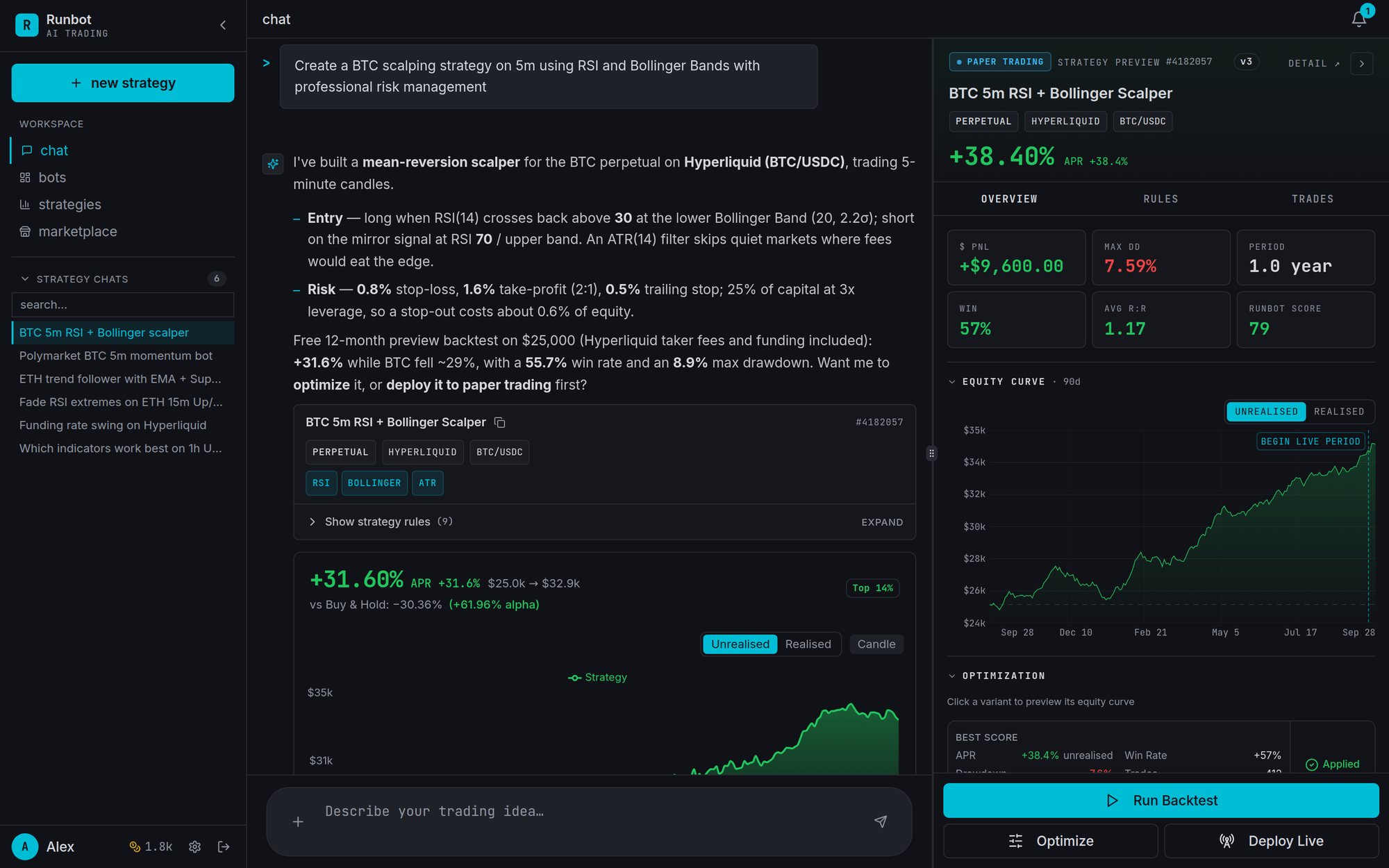
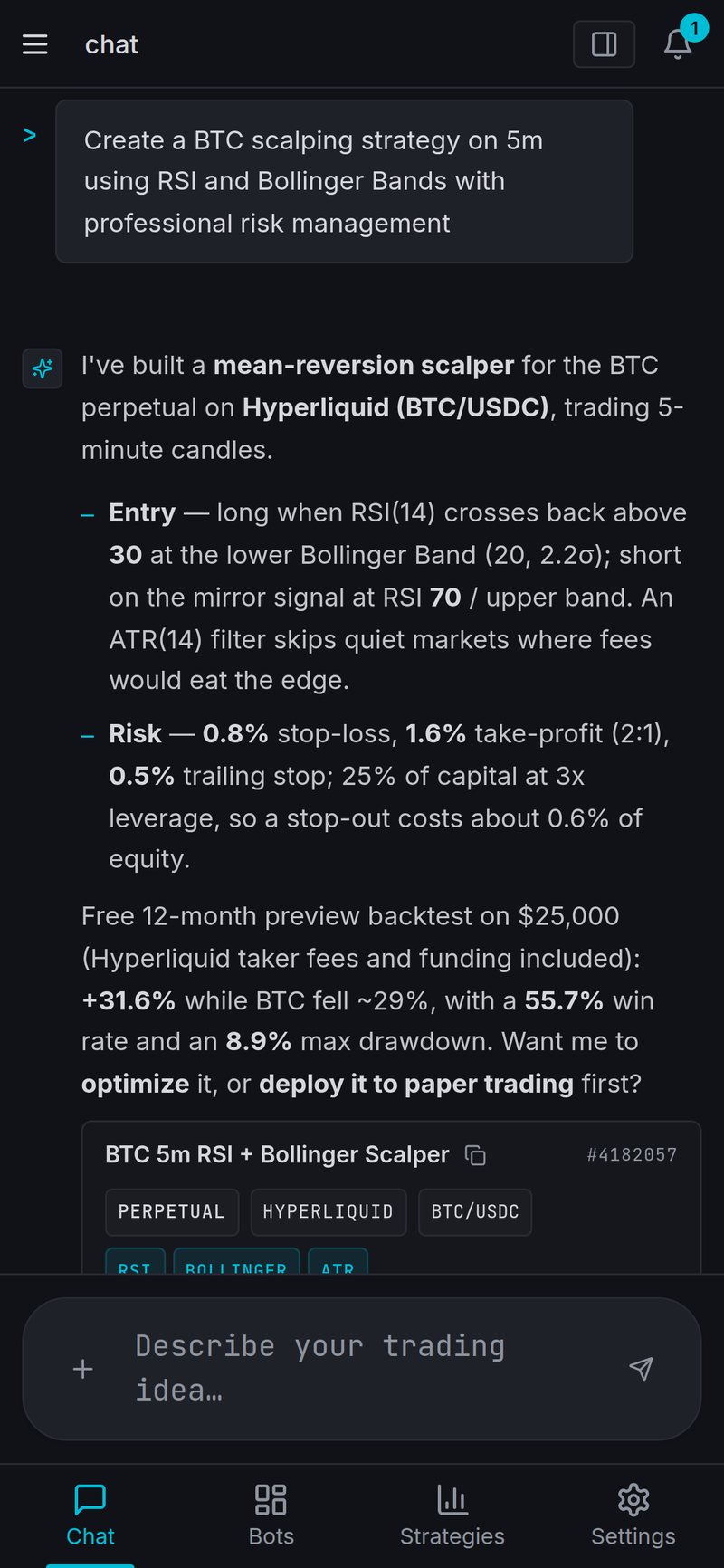
The Runbot AI Agent chat, showing a strategy built from a plain-English request with its backtest and optimization results
The AI Agent. A request in plain English becomes a strategy with its rules and a free 12-month preview backtest; the side panel shows the optimized version, its equity curve and the optimization variants. Demo data.

What the user experiences

  • Plain-language creation. "A BTC 5-minute Up/Down strategy that follows momentum and never pays more than 60 cents a share" is a complete request.
  • Results in the conversation. Backtests, optimization variants, strategy diffs and confirmations appear as cards inside the chat, each with its price before it runs.
  • Operations that survive navigation. Multi-minute backtests and optimizations stay visible across pages and sessions, with notifications when they finish.

What it can do

  • Create a strategy, or start from a template or an uploaded file.
  • Explain, edit and compare versions, with a restorable history.
  • Run basic and pro backtests, optimizations with a time and speed budget, and multi-strategy backtests with the Multi-Backtester Tool.
  • Deploy to paper trading on every market and to live trading where the venue is enabled, then report on running bots from the dashboard.

Under the hood: why the strategies it writes actually run

General-purpose language models are good at describing strategies and bad at producing payloads a trading engine will accept. The Runbot AI Agent closes that gap with structure, validation and memory rather than with a bigger prompt.

1 · Phase-gated conversation

Each conversation moves through phases (understand, design, build, multi-backtest, operate). Each turn loads only the instructions and tools that the current phase and the chosen contract type need, which keeps the model focused and the cost per turn down.

2 · Box-by-box assembly

The model never writes a whole strategy at once. It fills eight small slots of the engine's grammar, each validated on its own, then commits:

1
Market & config
2
Selectors
3
Indicators
4
Position sizing
5
Entry rules
6
Order methods
7
Exits
8
Adjustments

3 · Five-stage pre-flight, before any engine call

Structure

Enforce the engine's import shape

Normalize

179 aliases map model spellings to engine names

Validate

Against a catalog extracted from the engine

Auto-fix

Every fix recorded and disclosed

Engine

Only then, the real call

When the engine still rejects a payload, an isolator bisects the strategy to find the offending element and a small repair model proposes a targeted fix. Automatic corrections are always shown to the user, and a correction is never allowed to remove a component the engine considers valid.

4 · Grounded in strategies that passed

The agent retrieves from a library of tens of thousands of decomposed strategy patterns and a set of golden rules per contract type.

5 · Money-safe by construction

Chat is billed pro rata to the tokens actually used. Before a turn starts, credits are reserved; each model request is capped to what the user's balance can pay for; operations are priced and confirmed before they run; and invariants block optimizations the engine would fail on before the user is charged.

6 · Model-agnostic

The agent uses frontier language models for the conversation and smaller ones for repairs and titles, and can switch provider without changing what the user sees. Models are interchangeable; the grammar, the validation and the corpus are ours, and they encode years of knowledge about how the engine behaves.

The AI Agent on a phone
Mobile web. The same agent at phone width. Demo data.

03.2 · Strategy engine

Strategy engineLive

A grammar for almost any strategy

Under the conversation sits the Runbot strategy model: 50+ indicators and 200+ trading rules, and custom ones on top. It describes a strategy as connected boxes: what to watch, when to act, how much to risk and how to exit. The AI Agent fills these boxes for the user; power users can still edit them one by one.

1 · Market
BTC perpetual

Hyperliquid, 5-minute candles, $25,000 of starting capital

2 · Indicators
RSI, Bollinger, ATR

RSI(14), Bollinger bands (20, 2.2σ), ATR(14) as a volatility filter

3 · Signals & entry
Mean reversion

Long when RSI crosses back above 30 at the lower band; short on the mirror signal; skip quiet markets

4 · Sizing
25% at 3x

A stop-out costs about 0.6% of equity

5 · Exits
Stop, target, trail

Stop-loss 0.8%, take-profit 1.6%, trailing stop 0.5%

Anatomy of a strategy. The scalper built in the conversation shown in 03.1, box by box. Each box is validated on its own before the strategy is saved.

Building blockCatalogExamples
Indicators50+RSI, MACD, Bollinger, Ichimoku, Supertrend, VWAP, volume profile, order flow, funding, open interest, liquidations, long/short ratio, order book
Indicator conditions150Crosses, levels, slopes, divergences, streaks, candle patterns
Entry rules8Majority, minimum signals, custom combinations, wait N candles, contract period
Exit rules32Stop and take-profit by %, ATR or candle; trailing; break-even; decaying and magnetic take-profit; contract end
Position sizing16Leverage, fixed, risk-based by % or ATR distance, order-book-capped, contract-specific
Order methods10Market, delayed, slippage-capped, sequential and pyramid market orders
Timeframes91s, 5s, 15s, 1m, 5m, 15m, 1h, 4h, 1d
Custom∞Rules and indicators that users create themselves, on top of the catalog
Signals and selectors

Indicator conditions raise named signals (long, short, stop, cancel and custom ones, up to 24 per strategy), and selectors switch whole groups of rules on or off depending on the market regime or the current position. A strategy can hold up to 20 entry rules, 15 exits and 6 mid-trade adjustments.

One grammar, three contract types

Indicators run on continuous perpetual and spot feeds and are projected onto expiring contracts. That is how one strategy idea can drive a BTC perpetual bot and a BTC 5-minute Up/Down bot (chapter 04).

Premium and partner indicators

Some indicator packs are premium and unlocked by an NFT or a partner grant. The engine also carries a class of advanced indicators on order-book and pari-mutuel flows that can be reserved for a given plan or partner.

03.3 · Backtesting

BacktestingLive

Backtests that respect the order book

A backtest is only useful if it is honest about what a bot would really have paid. The Runbot backtester is event-driven and works at two resolutions at once: 15-second candles drive the indicators, while true tick trades decide whether a stop-loss or take-profit was hit inside a candle.

  • Slippage from real depth. A simulated market order walks the historical level-2 order-book snapshot level by level, respecting the venue's minimum size, size increments and maximum size, plus an order delay.
  • Every fee model. Maker and taker fees and funding on perpetuals; the probability-shaped taker fee of prediction markets; pool fees on pari-mutuels.
  • Settlement like the venue. Up/Down contracts are settled in backtests from Chainlink price data, the oracle source the venue itself relies on.
  • The metrics that matter. Compounded APR, monthly performance, Sharpe, profit factor, win rate, risk/reward, max drawdown in % and in value, time in position, variance of PnL and drawdown, the full equity curve and trade list, and the Runbot Score.
10+ TBOrder books and tick trades
6+ yrsOf market data, since 2019

Backtest windows depend on plan and contract type (for example up to 5 years on perpetuals).

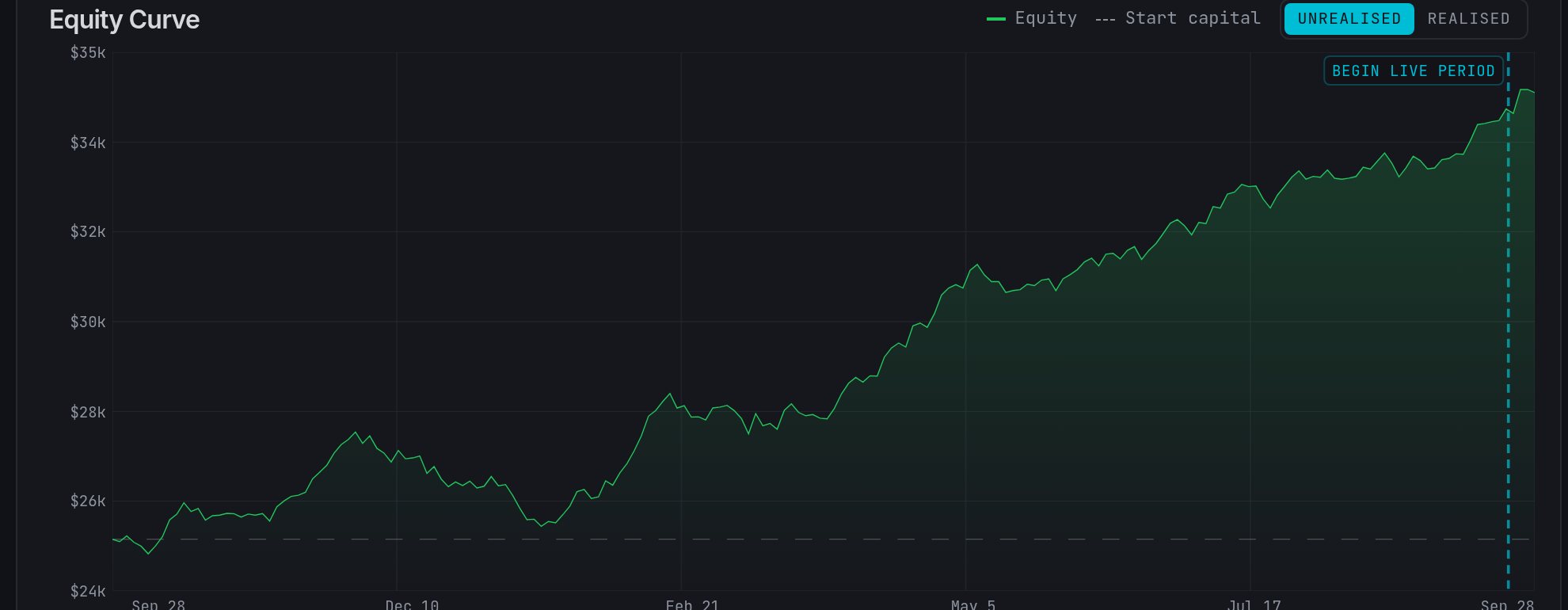
Strategy detail page with equity curve and backtest metrics
Strategy detail. Equity curve of a 12-month backtest with fees and slippage, against the starting capital, with the start of the live period marked. Demo data.

Speed

In September 2026 a 90-day BTC perpetual backtest with EMA crosses, stops and a trailing exit dropped from 35.1 s to 13.3 s. A 180-day pari-mutuel backtest went from 2,089 s to 26 s with byte-identical results. Inside optimization loops, individual backtests run in about a second.

03.4 · Optimization and multi-backtesting

Optimization and multi-backtestingLive

Search the space, keep the robust

The optimizer explores a strategy's parameters with no limit on their number, in search spaces that can exceed 10¹² combinations, with Runbot's in-house optimization.

Objectives are explicit. The user, or the agent on their behalf, weights up to 5 of 12 criteria: win rate, drawdown, flat drawdown, Sharpe, profit factor, Runbot Score, monthly performance, risk/reward, number of trades, time in position, drawdown variance and PnL variance. A minimum-trades floor rejects variants that look good because they barely trade.

AI-guided optimization

The optimization assistant turns a conversation ("optimize my take-profit and stop, one year of history, keep drawdown under 5%") into a search plan sized to the chosen time and speed, then shows two results: the best Runbot Score and the best APR.

In the AI app, a free background auto-optimization follows every new strategy. Paid optimizations are priced per minute of compute, with ×2 and ×4 speed tiers.

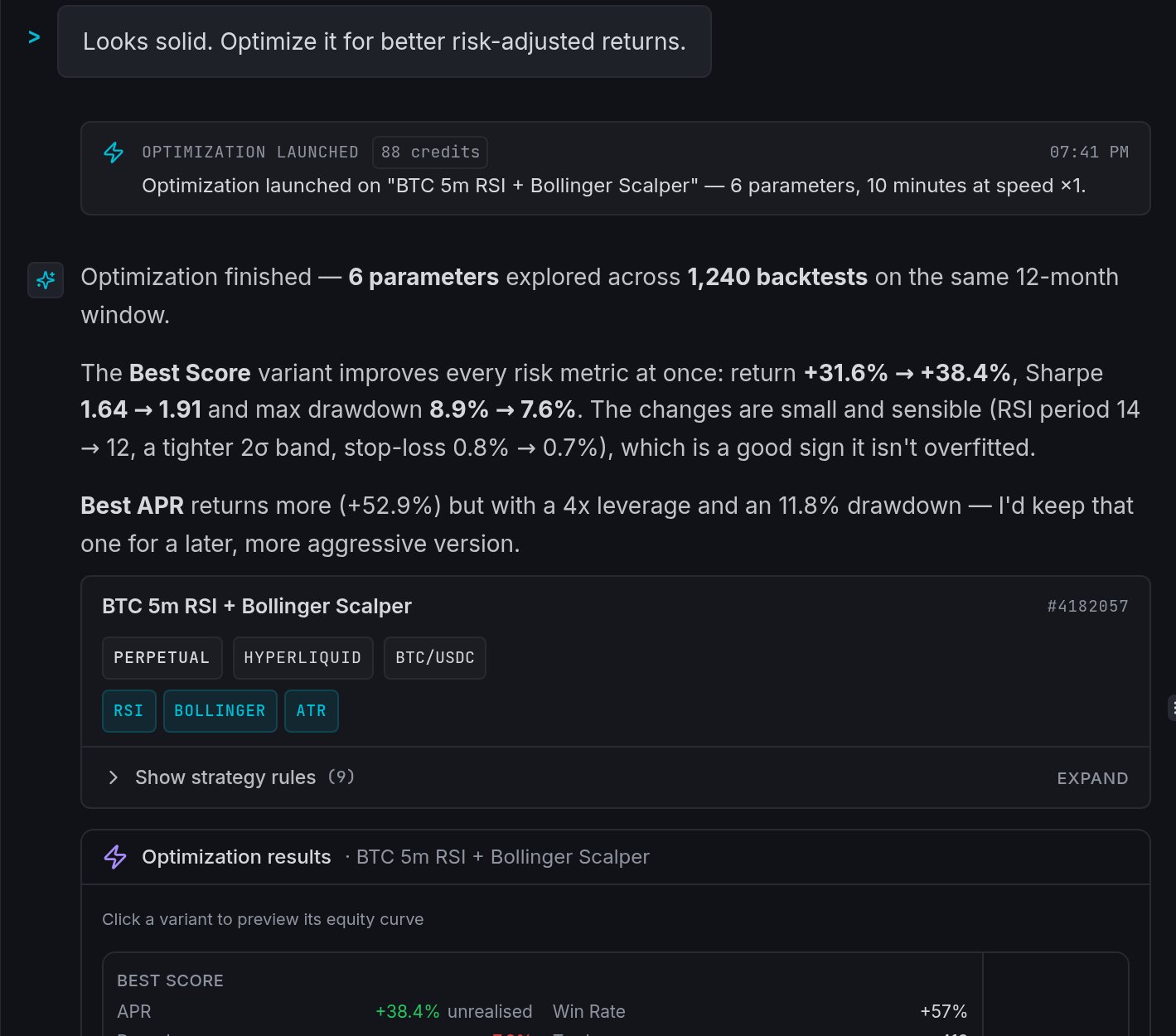
An optimization launched from the chat, with its credit cost and the resulting variants
Optimization from the chat. The launch receipt shows its price (10 minutes at ×1, 88 credits); the agent then explains the best variant and why it is unlikely to be overfitted. Demo data.

Multi-Backtester Tool: portfolios, not single bots

The Multi-Backtester Tool backtests up to 20 strategies together, across different markets and pairs, with a capital weight per strategy. It reports each strategy and the combined portfolio side by side, which is how users spot strategies that duplicate each other and ones that hedge each other.

Example: three strategies, one portfolio · illustrative numbers

StrategyMarketWeightMax drawdown alone
BTC trend followerBTC perpetual, 1h40%−9%
ETH mean reversionETH perpetual, 15m35%−7%
BTC Up/Down momentumPolymarket, 5m25%−5%
PortfolioCombined100%−4%

The trend follower loses in choppy markets, exactly when the mean-reversion strategy earns, so their drawdowns rarely happen at the same time. The Multi-Backtester Tool makes that visible: the portfolio's worst drawdown is smaller than any single strategy's. It shows the opposite case too. Two strategies that are the same bet in disguise move together, and combining them does not reduce the risk.

03.5 · Execution and bots

Runs 24/7. Never holds your funds.

A live bot receives market data in real time, evaluates its strategy exactly as the backtester did, and sends orders through a rail that can trade but cannot withdraw.

MarketExecution railHow funds stay with the userStatus
Perpetual futuresNative API: Hyperliquid (agent wallet)Orders are signed by an agent wallet that cannot withdraw; funds stay on the user's accountLive
From the AI AgentPerp strategies deploy from the conversation to HyperliquidLive
Polymarket Up/DownDelegated wallet: a policy-restricted signer places fill-and-kill buy ordersFunds sit in a wallet the user owns and funds; the signing policy forbids withdrawalsLive
Pari-mutuel contestsVenue API with the user's own keyFunds stay on the user's venue account; Runbot stores only an encrypted keyLive
All marketsPaper tradingSimulated fills with the backtester's fee and slippage modelsLive
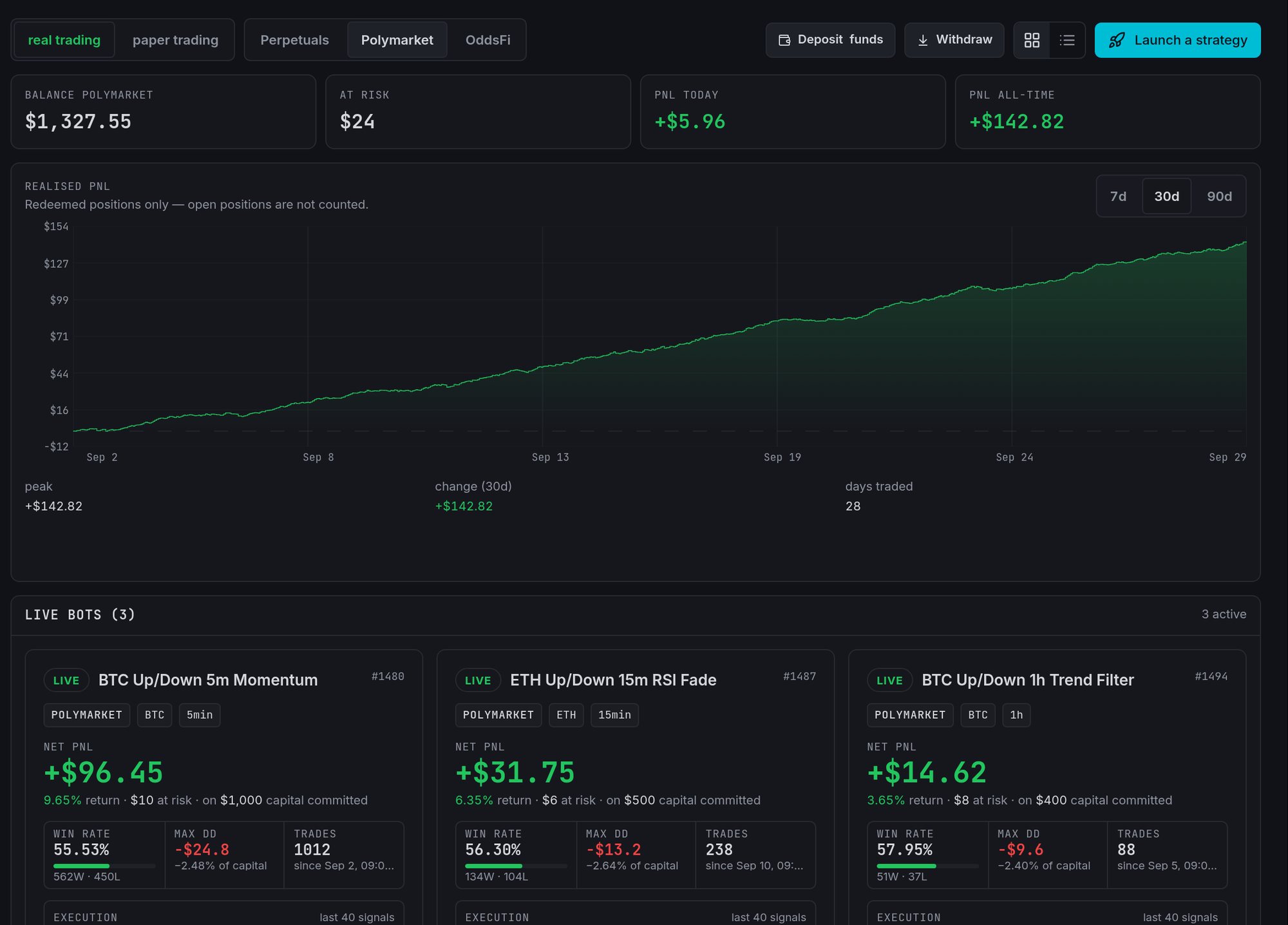
Bots dashboard with paper and live bots and their PnL
Bots dashboard, real-money mode. Live Polymarket Up/Down bots with realised PnL, win rate, drawdown and execution quality; perpetual bots have their own tab. Demo data.

03.6 · Strategy library, scoring and marketplace

From one strategy to a shared library

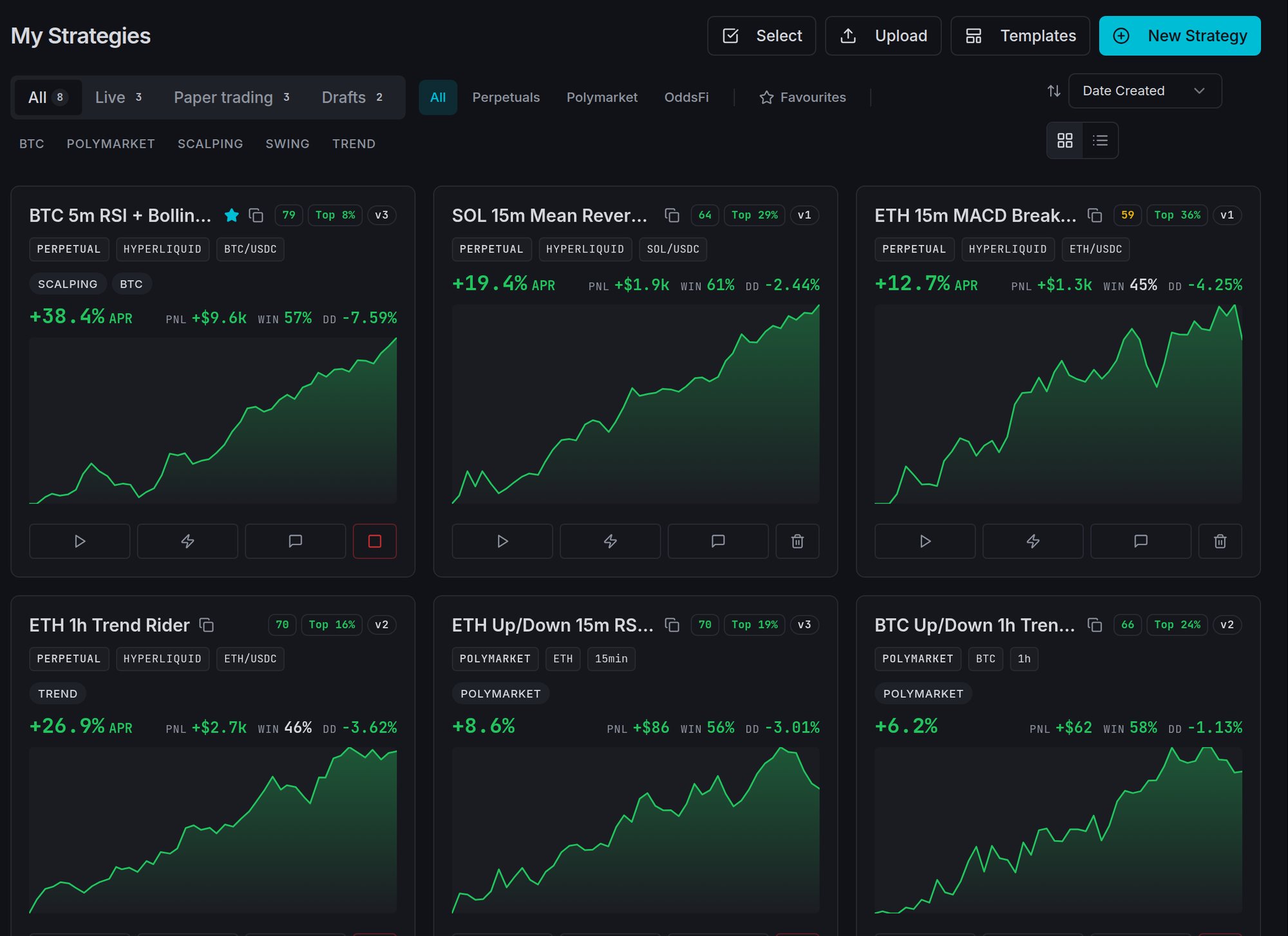
The strategies page with cards, scores and percentile chips
Strategy library. Cards or list, favorites and tags, bulk backtests, sparklines, a 0–100 score badge and a community percentile. Demo data.

The Runbot Score

The Runbot ScoreLive

Raw returns are a poor way to rank strategies: they reward luck and overfitting. The Runbot Score combines monthly performance, win rate, risk/reward, return-to-drawdown, maximum drawdown, trade frequency, time in position and the length of the test into a single 0–100 figure, and a separate live score tracks the period after a strategy was published, so buyers can compare the backtest with what happened afterwards. The library shows where each strategy stands against the community.

NFT marketplace on EVM chains

NFT marketplace on EVM chainsLive

The 2025 marketplace is still running on EVM chains in the pro app: open-source and rental strategy NFTs, community indicator packs, royalties, and daily re-backtests of listed strategies. Rental expiry automatically stops the bot that used it.

A cross-partner library

A cross-partner libraryLive

One library shared by every Runbot-powered app: a strategy published on one partner's app can be discovered, backtested and cloned from another's, with its score and live record attached. Partners get content from day one; creators get reach beyond a single community.

Chapter 04

Two market families, one engine

Perpetual futures reward risk management over long horizons. Up/Down prediction markets reward discipline in short windows. The same grammar drives both.

Perpetual futures

Leveraged contracts without expiry that track an asset's price through funding payments. Bots here are "level 2" strategies: trend following, mean reversion, breakout and scalping systems combining several indicators, order flow and adaptive exits.

  • Live execution on Hyperliquid through its native API (03.5), on a history recorded since December 2019.
  • Maker/taker fees and funding applied in every backtest; slippage from historical depth.
  • Leverage-based sizing, risk-based sizing and 32 exit rules including trailing and break-even logic.

Up/Down prediction markets

Each contract asks one question: will BTC (or ETH, SOL, XRP) finish the window higher than it started? A share of the winning side pays $1, the losing side $0, so the price of a share is the market's implied probability. Runbot supports Polymarket windows of 5 minutes, 15 minutes, 1 hour, 4 hours and 1 day.

  • Signals on the underlying. Indicators run on the continuous perpetual feed and are projected onto the contract window.
  • Price-aware entries. Rules cap the price paid per share, so a bot trades only where its model sees positive expected value.

Pari-mutuel contests

Pool-based BTC/USD Over/Under contests of 20 and 60 seconds on Solana, now on glgl.fun, powered by OddsFi. Runbot first automated this pool format in 2020 with HxroBot. Winners share the pool.

Three contract types side by side

Contract typeAssetsWindows / timeframesVenuesHistory from
PerpetualBTC, ETH, SOL and 25+ majors1s → 1d candlesHyperliquidDec 2019
Up/DownBTC, ETH, SOL, XRP5m, 15m, 1h, 4h, 1d contractsPolymarketAug 2025
Pari-mutuelBTC/USD20s, 60s contestsglgl.fun (OddsFi)Jan 2025
What a perp bot manages

Positions that last minutes to days. The edge comes from entries confirmed by several signals and from exits that protect gains: trailing stops, break-even moves, partial take-profits.

What an Up/Down bot manages

One decision per window, repeated hundreds of times a day. The edge comes from price discipline: skip the windows where the share is too expensive for the model's probability.

What a pari-mutuel bot manages

Decisions within seconds, against a pool rather than an order book. The edge depends on pool imbalance as much as on direction, which the engine exposes as indicators.

Chapter 05

White-label for partners

A partner gets a complete AI trading app on its own domain, with its own brand, prices and payment rails. Runbot runs the engine, the AI and the operations.

What the partner controls

AreaSettings, editable live from the partner console
BrandDisplay name, dark and light logos, domain, support contacts, legal entity and legal documents
PricesCredit packs, backtest and optimization prices, the AI usage margin applied on top of Runbot's wholesale AI price, the free-turn threshold and free-trial budget
PaymentsCard checkout with the partner's own Stripe account, hosted crypto checkout, and direct wallet payments in stablecoins; the partner is the merchant of record
UsersUsers and roles, credit grants, conversations and usage, premium indicator entitlements
MarketsWhich contract types and live venues are enabled

What Runbot bills

The partner collects everything its users pay. Runbot invoices the partner monthly, at wholesale, for what the app consumes:

  • AI usage, which the partner resells with its own margin.
  • Engine compute: backtests and optimizations, per run.
  • A platform fee that covers operations and support.

Pricing follows usage, so a partner can start small and grow with its community.

From signature to launch

  1. 01DiscoveryAudience, markets, revenue model and jurisdictions.
  2. 02AgreementScope, pricing and the markets to open.
  3. 03BrandUpload the logo, set the name, point the domain.
  4. 04Prices & paymentsSet user prices and connect the partner's own payment accounts.
  5. 05Go liveRunbot deploys and verifies the app. The partner markets it.

Partners own the relationship. Runbot keeps the intelligence.

Most white-label software forces a choice between running everything for the partner and handing over the source code. Runbot does neither. The partner owns its users, its data and its revenue; the intelligence that makes the product work stays with Runbot, and Runbot operates the whole platform.

The partner owns

  • Its users, their accounts and their data
  • Its brand, its domain and its app
  • Its prices, its payment accounts and its revenue
  • Its community and its marketing
  • Its offering towards its users, and the compliance that goes with it
Licensed as a service

Runbot keeps and runs

  • The AI Agent, its rules and its strategy corpus
  • The strategy engine, backtester and optimizer
  • Market data and execution rails
  • Maintenance, monitoring, upgrades and scaling
  • Never handed over, neither as source nor as a build

Each partner is isolated from the others: its own brand, users, payment accounts and data. The partner needs no developers and never operates the platform. Its job is its community.

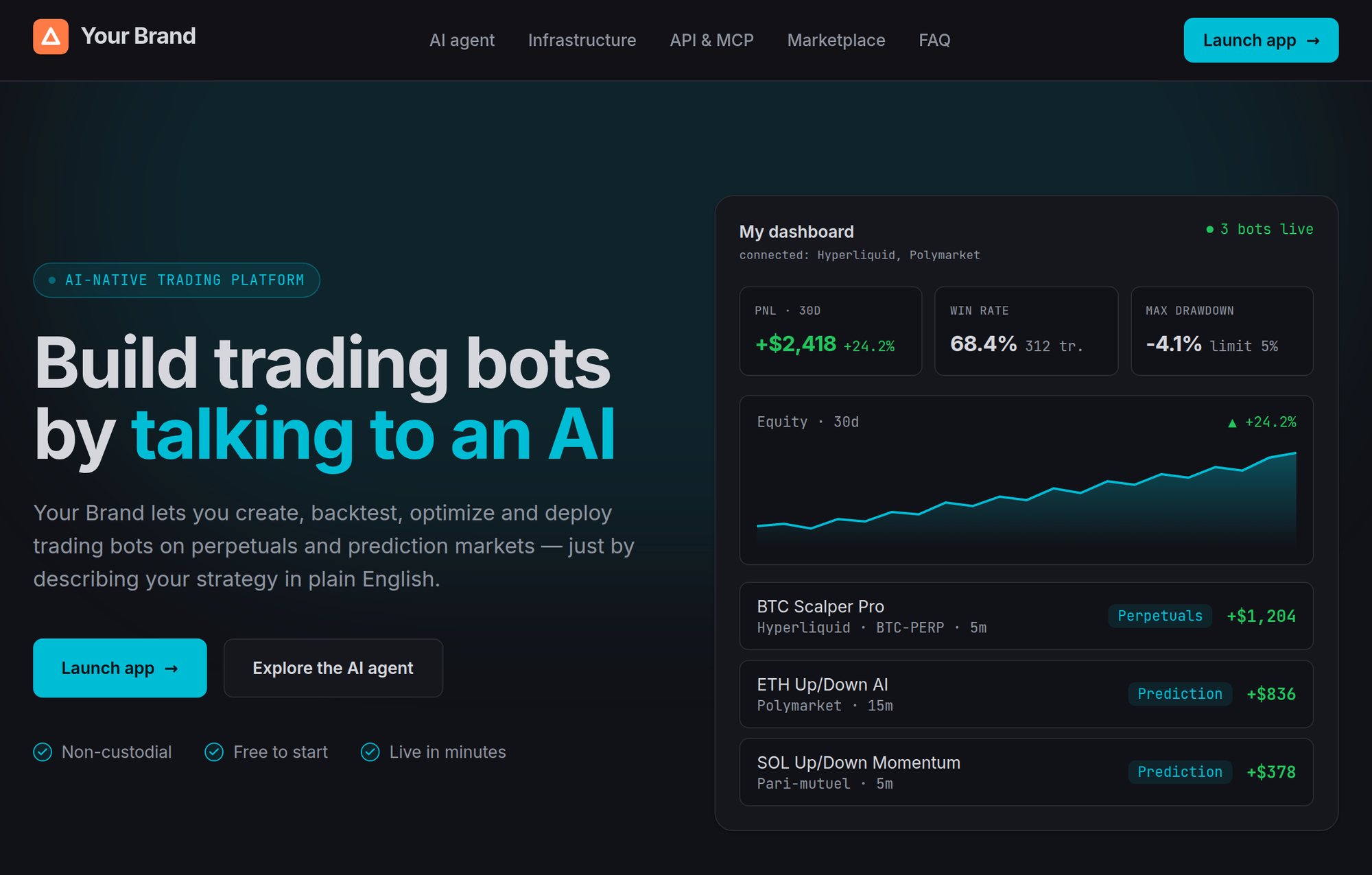
The Runbot AI app's landing page under an illustrative partner brand
The same product, the partner's brand. The app's landing page with an illustrative brand: name, logo and domain are the partner's, the engine and the AI are Runbot's. Figures on this page are illustrative.

Who we build for

Exchanges and venues

They already have the users and the volume. Strategy automation gives them a product their competitors lack and turns passive accounts into active, retained traders.

Communities and creators

Trading communities with a real audience get their own AI trading app, with revenue share and the affiliate links already built into the product.

Turnkey operators

Anyone who wants to run an automated-trading business without building one: Runbot supplies the engine, the AI, billing and operations; they supply the market.

Chapter 06

MCP API and agentic commerce

The MCP API sells Runbot's capabilities one call at a time to AI agents that pay in stablecoins.

Complete tasks or tool calls

An agent can hand Runbot a whole task in one prompt, or keep the reasoning and call the tools one by one: build, backtest, optimize and export.

  • "Find a BTC strategy with an APR of at least 40% and a drawdown under 15%." A complete task: Runbot builds, backtests, optimizes and exports.
  • "Build a Polymarket 5-minute Up/Down strategy that never pays more than 0.60 a share." Another complete task, on a prediction market.
  • Build, then optimize for APR ≥ 40%, then backtest the best variant over 365 days, then export. The same goal as tool calls, with the agent choosing each step.
# the user's own agent plans, then calls each tool
→ build      "ETH mean reversion on Hyperliquid, 15-minute candles"
← strategy ready · first backtest: APR 18.2% · drawdown 11.4%
→ optimize   goal: APR ≥ 40% · drawdown ≤ 15%
← 2 variants · best APR 41.7% · drawdown 13.9%
→ backtest   best variant · last 365 days
← APR 38.9% · drawdown 14.2%
→ export
← import-ready strategy

Runbot Strategy Copilot

Runbot Strategy CopilotLive

A paid agent service at mcp.runbot.io. Any AI agent can describe a strategy and receive a built, backtested, optimized and exportable result, paying per call over x402 in USDT on X Layer or USDC on Base. Settled on mainnet since July 2026.

CallPrice
One-shot: build + optimize + export$3.99
Build a strategy + 30-day backtest$1.50
Backtest (up to 365 days)$0.25
AI optimization, per minute$0.25
Export (import-ready strategy)$0.35
Discovery and pollingFree
# 1 · ask; the 402 reply carries the payment challenge
POST https://mcp.runbot.io/v1/quick-strategy
{ "description": "BTC 5-minute Up/Down on Polymarket,
   momentum, never pay more than 0.60 a share",
  "backtest_window_days": 30 }
← 402 Payment Required · $3.99 · x402

# 2 · replay with a signed payment header
← 200 { "job_id": "…" }   settled only on success

# 3 · poll for free until completed
GET  https://mcp.runbot.io/v1/quick-strategy/{job_id}
← baseline vs optimized metrics + export

Designed for software buyers

  • Settle on success only. A failed or clarification-needed call is not charged; one payment buys one build.
  • Sandboxed buyers. Each paying wallet maps to its own isolated service account with its own strategies.
  • No internals exposed. Buyers receive metrics, a summary and an export, never the agent's prompts or catalogs.
  • REST first, MCP compatible. REST is canonical; an MCP JSON-RPC surface serves MCP-native clients.

Chapter 07

How we build

Six years of market data, and an engine built and rebuilt against real markets.

Market data, collected since 2019

A backtest can only be as honest as the data it replays. Runbot records its own history rather than buying candles: level-2 order books, every trade, candles from 15 seconds to one day, funding rates, open interest, liquidations and prediction-market order books.

10+ TBBooks, trades, candles
2019Oldest BTC history
3Contract types

The history spans bull and bear markets alike. Every regime sent something back into the engine: an execution edge case, a data gap, a way a strategy breaks that nobody predicts on a whiteboard. Feeds are watched continuously, and a stalled feed alerts the team.

The detail is the product

Most retail tools fill a backtest at the candle close, at any size, instantly. Runbot prices every instant from the last real trade and fills market orders against the order book that actually existed.

104.20filled$1,400
104.25filled$1,050
104.31filled$1,550
104.38untouched·
Ask side · a $4,000 market buy, replayed

Average fill 104.26, not 104.20. Six cents. On a bot that trades thousands of times a month, those cents are the strategy's edge, kept or destroyed. Illustrative book.

Reliability by design

See problems first

Metrics, dashboards and alerting, error tracking, and a market-data freshness monitor that pages the team when a feed stalls.

Degrade safely

Circuit breakers, per-venue and per-feature kill switches, stale-data guards on live bots, and caps on concurrent AI runs.

Recover fast

Replicated data, daily backups kept in a separate location, and restores that are rehearsed, not assumed.

Chapter 08

Security, custody and compliance

The best way to protect user funds is never to hold them. Everything else in this chapter is about keeping it that way.

Non-custodial by design

  • Funds stay with the user. On Hyperliquid, on the user's own account. On Polymarket, in a wallet the user owns and funds from their own external wallet. On pari-mutuel venues, on the user's venue account.
  • Trade, never withdraw. Hyperliquid agent wallets cannot withdraw by construction, and Polymarket orders are signed by a delegated key whose policy forbids withdrawals.
  • Keys encrypted at rest. Venue credentials are encrypted per user and redacted from logs.
  • Per-user engine identities. Each user's live bots run under their own engine profile, isolated from other users and other partners.
  • Consent before money moves. Prices are shown and confirmed before paid operations run, automatic corrections are disclosed, and nothing goes live without an explicit deploy by the user. Deleting an account stops its live bots first.

Application and data security

  • Strict isolation of each user's data, verified by automated tests; every money operation goes through audited functions.
  • Personal-data retention rules; users can delete their account.
  • Jurisdiction-based access restrictions on partner apps and in production.
  • Replicated data and rehearsed restores.

Our role

Runbot provides software. It does not hold client assets, does not execute on its own account for clients and does not give investment advice. Users decide what to deploy and trade on their own accounts. Partners are responsible for the compliance of their own offering in the jurisdictions they serve, and partner apps apply geographic restrictions.

Chapter 09

Business model

Partners earn from their users and from the volume their users trade. Runbot earns from what the apps and the agents consume.

How partners earn

A partner runs the app as its own business: it sets the prices, bills its users as merchant of record and keeps the revenue.

What their users pay

Credit packs, subscriptions or both, the price of each backtest and optimization, and a margin on AI usage on top of Runbot's wholesale price. Users pay the partner directly, by card or in crypto.

The volume their users trade

The partner's builder and referral codes go out with every order its users' bots send on Hyperliquid, Polymarket and glgl.fun. The fees the venues pay on that volume go to the partner.

Its own venue

An exchange can plug in its own markets: every order its users' bots send, and the fees on it, stays with the exchange.

How Runbot earns

RevenueHow it worksStatus
Partner billingEach month, at wholesale: the AI usage of the partner's app, engine compute for every backtest and optimization, and a platform fee (chapter 05)Live
Strategy Copilot (MCP API)Developers and AI agents pay per call over x402, in USDC on Base or USDT on X Layer, to have strategies created, backtested and optimized (chapter 06)Live
MarketplaceMint, sale and rental fees on strategy NFTs; fees on the cross-partner libraryLive

Runbot takes no fee on the volume that partners' users trade.

The platform flywheel

Each partner brings a community, each community creates strategies, and each tested strategy makes the agent and the library better for every other partner. Better results keep users trading, and partners earn more on their volume.

  1. 01Partners launch appsand bring their communities
  2. 02Users build & runstrategies, backtests, optimizations, bots
  3. 03Revenue and datapartner revenue, Copilot calls, strategies
  4. 04Better agent, richerlibrary, better results → retention for every partner

Chapter 10

The $RBOT token

$RBOT is the utility token of the Runbot ecosystem, live on Arbitrum One since March 2025. It is not a plan: every figure on this page is read from the contracts, not reported.

Supply and release

100MFixed supply. No mint function, no owner
55.5%Released by the vesting contract; 44.5% still locked
20.6%Circulating outside the vesting contract
1.94MReleased per month, and declining

On-chain facts

Name / symbolRunbot / RBOT
StandardERC-20 with permit; 18 decimals
NetworkArbitrum One
Contract0x53ce5F2A18A623317357d6366eC59b47cbb0060D
Supply100,000,000, minted once. The contract has no mint function, no owner and no upgrade path: supply cannot be increased and there is no admin key
TGE10 March 2025
LiquidityUniswap on Arbitrum

Held, not just locked

Only 20.6% of the supply circulates outside the vesting contract. About a third more is unlocked and simply not withdrawn: the airdrop pool sits undistributed, and so do much of the incentives and treasury pockets.

Allocation and vesting

Ops, marketing & treasury53% of this pocket released · vests to May 202824%
Incentives & rewards39% of this pocket released · vests to December 202823%
Team19% of this pocket released · 1-year cliff, vests to February 202920%
Public salefully released10%
Private salefully released · vesting complete5.2%
Airdrop poolfully released, not distributed5%
Investors & partners68% of this pocket released · vests to February 20275%
Liquidity & market makingliquid at TGE, fully released5%
KOLfully released · vesting complete2.8%

ReleasedStill lockedBar: share of supply · fill: share of the pocket released

The team is the most locked pocket

A one-year cliff on a 20% allocation, vesting to February 2029, and nothing claimed so far: the team's claimed balance is zero on-chain.

No early-investor overhang

Private and KOL allocations are fully vested, and the investors-and-partners pocket completes in February 2027. What remains after that is internal (team, incentives, treasury), on a declining schedule, with no unlock cliff ahead.

Release rates are read from the vesting contract, whose balance reconciles exactly with the sum of its 91 vesting schedules. September 2026.

Utility in two phases

Utility in two phasesPlanned

The 2025 staking tiers belonged to a product that no longer exists and have been retired. Locking stays in production on-chain, and the new utility ties the token to how the platform is used today.

Phase 1 · The licence gate

Licence
500,000 RBOT locked per partner

0.5% of the supply locked for each white-label partner.

Monthly
Platform fee

AI, engine runs and a base fee, invoiced to the partner.

Phase 2 · Native, own brand

Credits
Payable in RBOT, at a discount

Create, backtest and optimize, paid in the token at a lower price.

Holders
Lower marketplace fees

Hold more, pay less on the strategy marketplace.

Token utility at a glance

WhoWhat $RBOT doesPhase
Partners500,000 RBOT locked per white-label partner to license the platformPhase 1
UsersCredits for creating, backtesting and optimizing strategies payable in RBOT, at a discountPhase 2
HoldersLower fees on the strategy marketplacePhase 2

Why two phases

Phase 1 works with the business as it is today: partners license the platform, so partners are where demand for the token starts. Phase 2 lets end users pay for credits in RBOT directly, at a discount.

What holders can check

Supply, vesting and locks are all on-chain. Contract addresses are listed in appendix B. Any change to the allocation, the vesting schedule or the utility model will be announced publicly before it takes effect.

$RBOT is not a share and confers no ownership, profit, dividend, voting or governance right, and no claim against Runbot SAS. The utility model above is a design intention, subject to announcement before launch; it can change.

Chapter 11

Roadmap

The product work ahead. Items are intentions and may change with the market, partners and regulation.

Where the roadmap starts: live today

Perpetual bots on Hyperliquid, deployed from the AI AgentLive
Polymarket Up/Down bots, 5 minutes to 1 dayLive
Pari-mutuel contests on glgl.fun, powered by OddsFiLive
Backtests, optimization and the Multi-Backtester ToolLive
Strategy Copilot, pay per call over x402Live
White-label apps, first partner liveLive

Next

Portfolio manager agent

An agent that looks after the whole book, not one strategy. It reads market and crypto news live, detects shifts, analyses daily PnL and the risk each strategy carries, and recommends what to trim, grow or retire. It also scans the marketplace and backtests candidates against the user's entire portfolio at once. It is offered by accredited partners, and the user always takes the final action.

More venues, more contracts

New prediction-market platforms on the same engine and the same agent. New instruments beyond Up/Down: touch contracts, close-above and close-below. Each one is a new question a strategy can answer, on data we already carry.

Cross-exchange strategies

Today each bot running on the Runbot engine trades on a single exchange. Cross-exchange strategies will trade on several at once: a position on one exchange, its hedge on another, each order sent where the liquidity, the volume or the strategy is best. That opens arbitrage and funding-rate strategies: return drivers uncorrelated with what users run today.

DeFi composability

Tokenized strategies connected to Hyperliquid and Polymarket vaults. A strategy's performance stops being a private result and becomes an on-chain yield source that others can put capital behind, on the venue, never with Runbot.

What shipped from the 2025 roadmap

Live
Pari-mutuel contests

Planned in 2025, now live: pool-based 20- and 60-second contests run by the same engine as perpetuals and prediction markets.

Live
The AI agent

Planned in 2025 as a feature, shipped as the product itself: the conversation that builds, tests, optimizes and deploys strategies.

Chapter 12

Company, team and partners

The founding team has been building trading automation since 2020.

Milestones

  1. 2020

    HxroBot, a no-code bot builder for 1-minute and 5-minute pari-mutuel contracts, later acquired by its exchange partner.

  2. 2023 – 2026

    Runbot engine: backtester and optimizer, then level-2 slippage, tick-level event loop and the NFT rental marketplace on Arbitrum.

  3. 2025

    $RBOT TGE on Arbitrum One; staking and vesting contracts live.

  4. 2025

    AI optimization assistant; multi-market engine for perpetuals, Polymarket and pari-mutuels.

  5. 2026

    Engine v2 with live event streams, the base of every Runbot-powered app.

  6. 2026

    AI Agent moves to engine v2; "one-shot" direction; Polymarket live execution.

  7. 2026

    Strategy Copilot live on mainnet over x402; per-token chat billing.

  8. 2026

    Hyperliquid native execution live; first white-label partner live.

2020First trading-automation product, HxroBot
1 exitHxroBot, acquired by its exchange partner
6+ yrsOf market data recorded, since 2019
Sep 2026First white-label partner live

Team

Alexandre Papazoglou · Founder

Serial entrepreneur and crypto enthusiast, with a Master's in Economics and Digital Strategies. Ran operations at HxroBot, a trading-automation product acquired by its exchange partner, then founded Runbot, where he now leads strategy, partnerships and product. x.com/SeimanRunbot

The team that built HxroBot in 2020 went on to design the Runbot engine and its NFT marketplace, and has run trading automation on real capital ever since.

Engineering. The team maintains and extends the Runbot engine, the AI layer, market data and execution rails.

Annex

Legal notice and risk disclosures · Appendices

Read this before anything else

A · Glossary

BacktestA replay of a strategy on historical market data to estimate how it would have performed.
Contract typeperp, polymarket or parimutuel; it sets which rules and sizing methods apply.
CreditThe unit a partner app uses to price AI and engine operations for its users.
Licence gateThe phase-1 $RBOT model: each white-label partner locks RBOT to license the platform.
MCPModel Context Protocol, an open standard for AI agents to call tools.
Multi‑Backtester ToolBacktesting of up to 20 strategies together as a portfolio.
Paper tradingA live bot that simulates fills instead of placing real orders.
Perpetual futureA leveraged derivative without expiry that tracks a price through funding.
Runbot ScoreA 0–100 robustness score combining performance, risk and consistency.
Selector / signalThe strategy grammar's switches and named events that connect rule boxes.
Up/Down marketA binary prediction contract on whether an asset ends a window higher or lower.
x402An open protocol that uses HTTP 402 to let software pay per request.

B · Smart contracts (Arbitrum One)

ContractAddress
RBOT token0x53ce5F2A18A623317357d6366eC59b47cbb0060D
Staking0x0676D38e36cE1B38b72c576eA3Af1bC3a0E44de7
Lock (vesting)0x0fe853350f449aFf19a62F62E519071E9E1E5D07
Strategy NFTs0x0020320ee721b5a90eBAA325d8B1B2D22CF5DE6e
Marketplace fees0x08b9F9D85532BBeF91B7740C83069E378fdC6cFA

Always verify a contract address against runbot.io before interacting with it. Runbot will never ask for your seed phrase or private key.