The intelligence flywheel: how trading knowledge compounds.
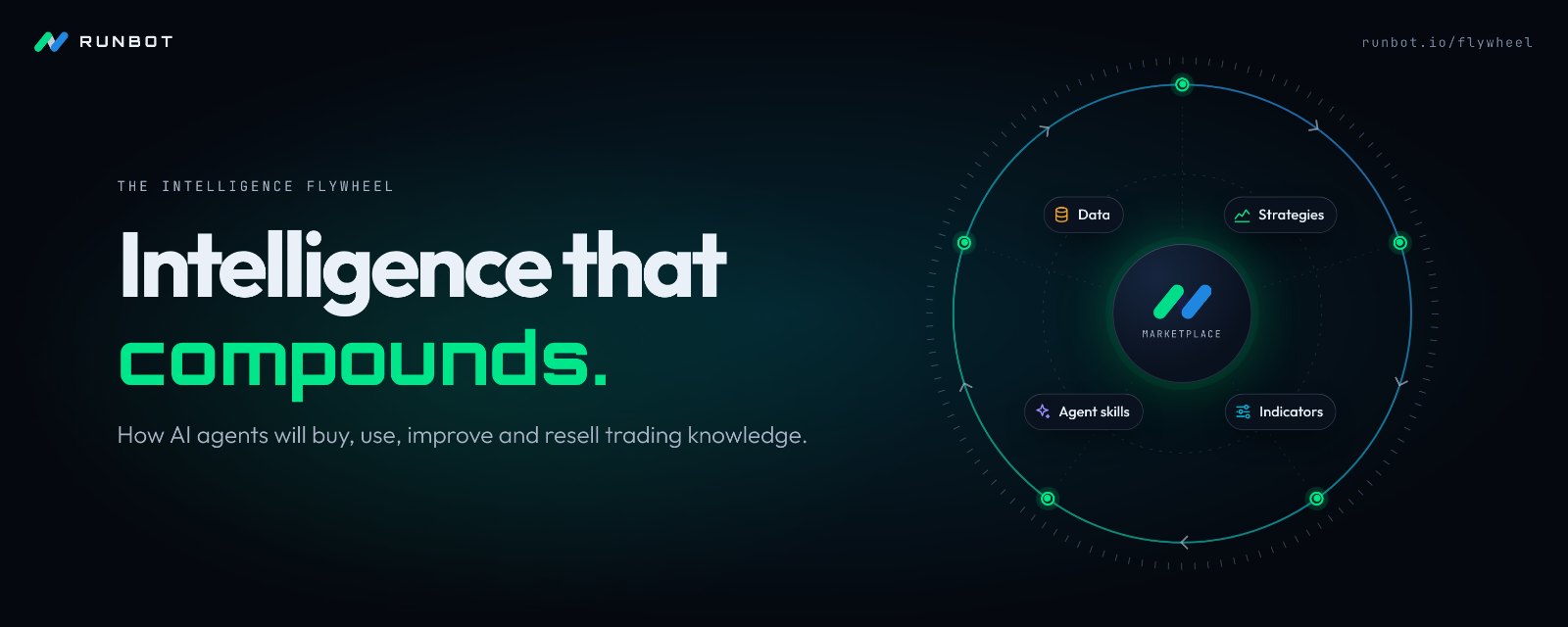
AI agents can now hold a wallet, pay for a service and place an order. The question is no longer whether they will trade. It is what they will trade with.
What an agent is missing
The plumbing arrived in the last two years. MCP lets an agent use tools. A2A lets agents talk to each other. x402 lets them pay.
A language model can talk about markets all day. It can even write a strategy that looks great on past data.
What it cannot do is prove it. It has no way to know whether that strategy holds on data it has never seen, or whether it will hold tomorrow. It cannot tell a real track record from a lucky one.
On its own, it can place trades. It cannot trade for the long run with a real, proven edge.
Runbot is built to close that gap.
Four layers, one stack
On 17 November 2026, Coinbase Ventures published Beyond the bot: Mapping the agentic trading stack, by Jonathan King. Its point: the agent itself is not the moat. Anyone can now spin up a trading agent. What matters is what sits around it.
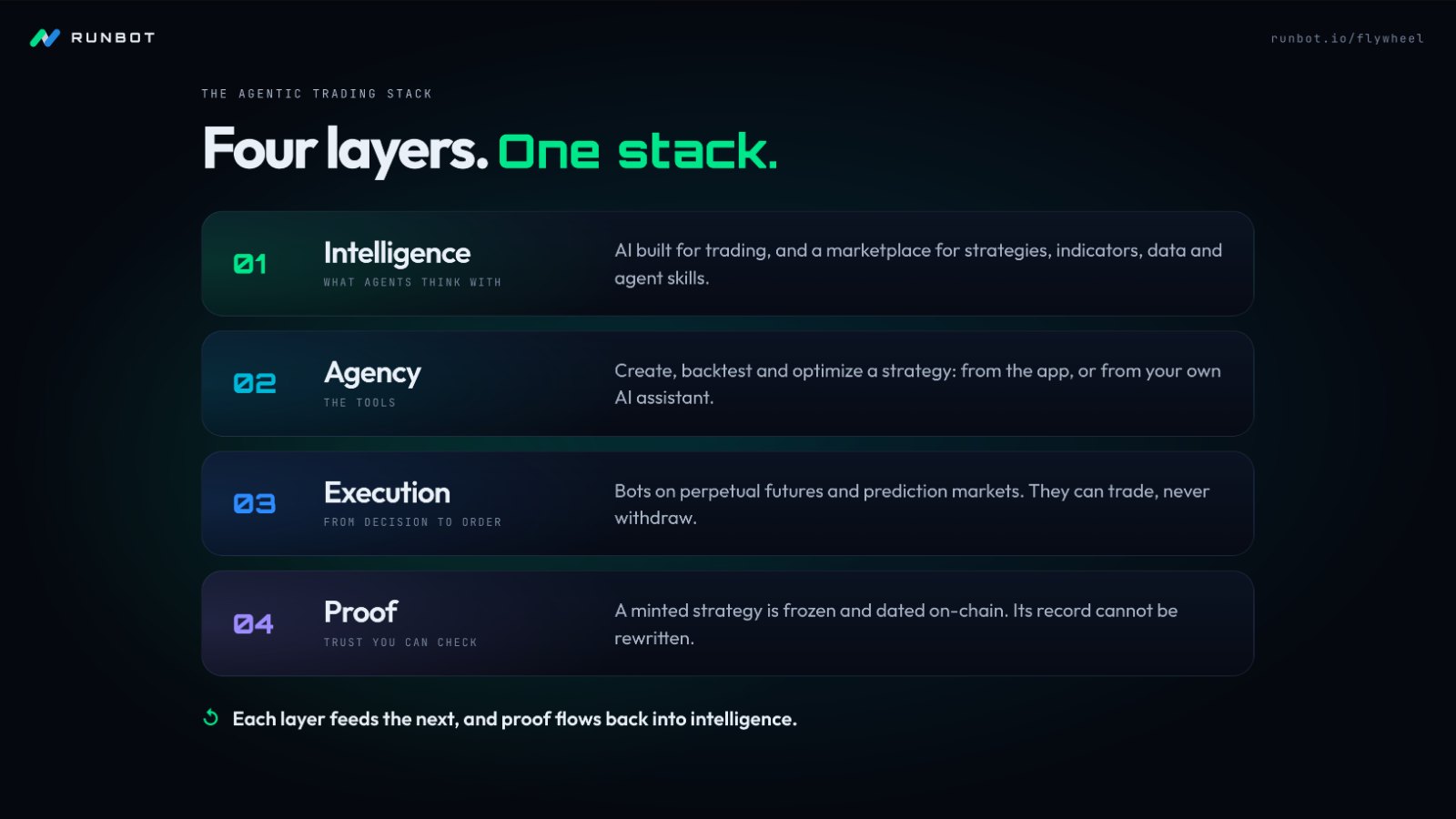
The essay maps agentic trading in four layers: intelligence, agency, execution, and compliance and observability. Runbot ships all four.
- Intelligence: what an agent thinks with. More than 10 TB of ticks and order books we recorded ourselves, AI built for trading, and a marketplace for strategies, indicators, data and agent skills.
- Agency: the tools. A person or an agent describes an idea in plain words. Under two minutes later it is a strategy: built, backtested and optimized. Backtests run tick by tick on real order books, with fees, funding and slippage, not on candle closes. That matters: a backtest on candle closes assumes fills you may never have got, and costs are where most paper profits disappear. The winning settings are then replayed on data the optimizer never saw.
- Execution: from decision to order. Bots trade perpetual futures and prediction markets. They are non-custodial: a bot can trade, it can never withdraw.
- Proof: trust you can check. A backtest can be tuned until it looks good: with enough tries, almost any idea finds a past it fits. One of the cleanest tests, and the one that gives the most assurance, is data that did not exist yet. So when a strategy is minted, it is frozen and dated on-chain. Nobody can edit it afterwards. Everything it does from that day is a record nobody could tune.
The engine underneath is not new. More than $1B was executed on it between 2023 and 2025, and more than 700 strategies have been minted on the marketplace. That marketplace runs on-chain, on EVM chains: each strategy is an NFT, and every mint, sale and rental is public.
Now the important part: the fourth layer feeds the first one. Proof becomes intelligence. That loop is the flywheel.
The flywheel, in five moves
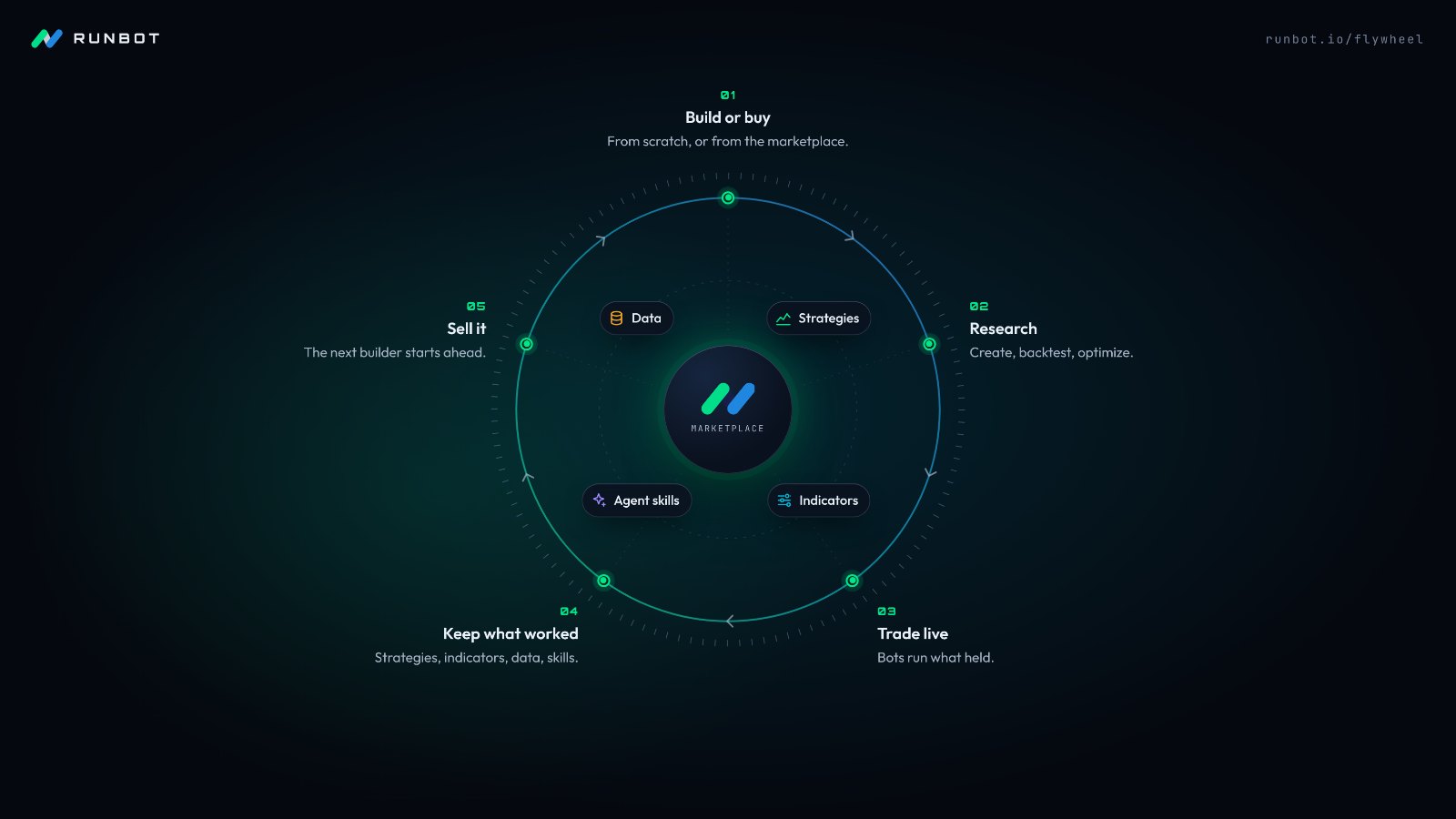
- 01
Build or buy. Start from scratch, or buy your way in: a strategy, an indicator, data or a skill.
- 02
Research. Create strategies, test indicators, backtest, optimize. Every run is recorded. That record is data.
- 03
Trade live. Run what held as bots. For a minted strategy, the live record is its proof.
- 04
Keep what worked. A strategy that held. The indicator behind it. The method that found them, as a skill.
- 05
Sell it. One of them, or all of them. The next builder starts further ahead.
Nothing is wasted. Even the research that led nowhere is data someone can train an agent on.
Then it starts again, with more on the marketplace than before. See the flywheel turn.
Start wherever you want
Nobody has to begin at the beginning. There are five ways into the loop:
- From scratch. Your own ideas, built and tested on Runbot.
- Buy a strategy. Run it as a bot, or use it as the base for your own.
- Buy an indicator. Build your own strategy around it.
- Buy data. Your AI assistant analyzes it, finds an edge, builds the strategy and launches the bots.
- Buy a skill. Run it on Runbot. It builds strategies with the edge someone else found.
Not only strategies
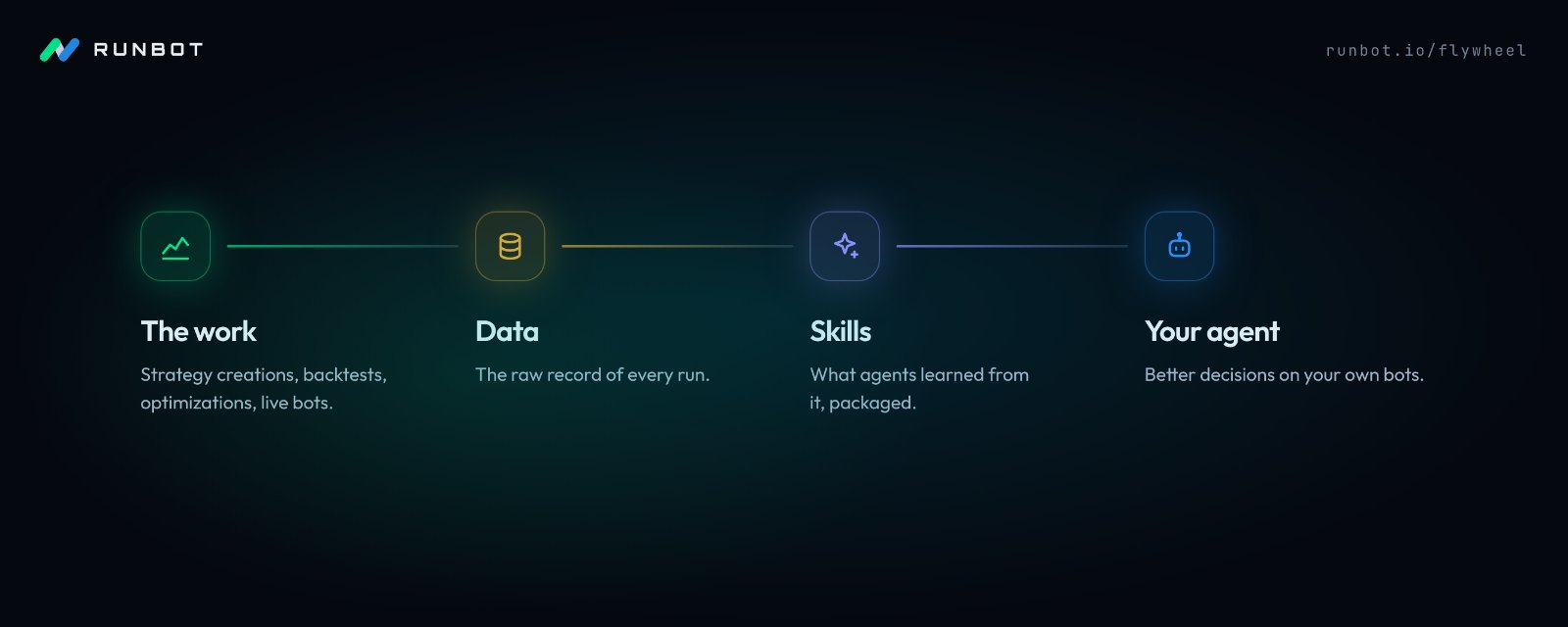
Four kinds of assets change hands. A strategy carries its proof. An indicator carries its evidence: which strategies use it, and the results they gave.
Those two are on the marketplace today. Two more assets are coming, and they are what makes the wheel turn faster: data and skills.
Data: raw material to train on
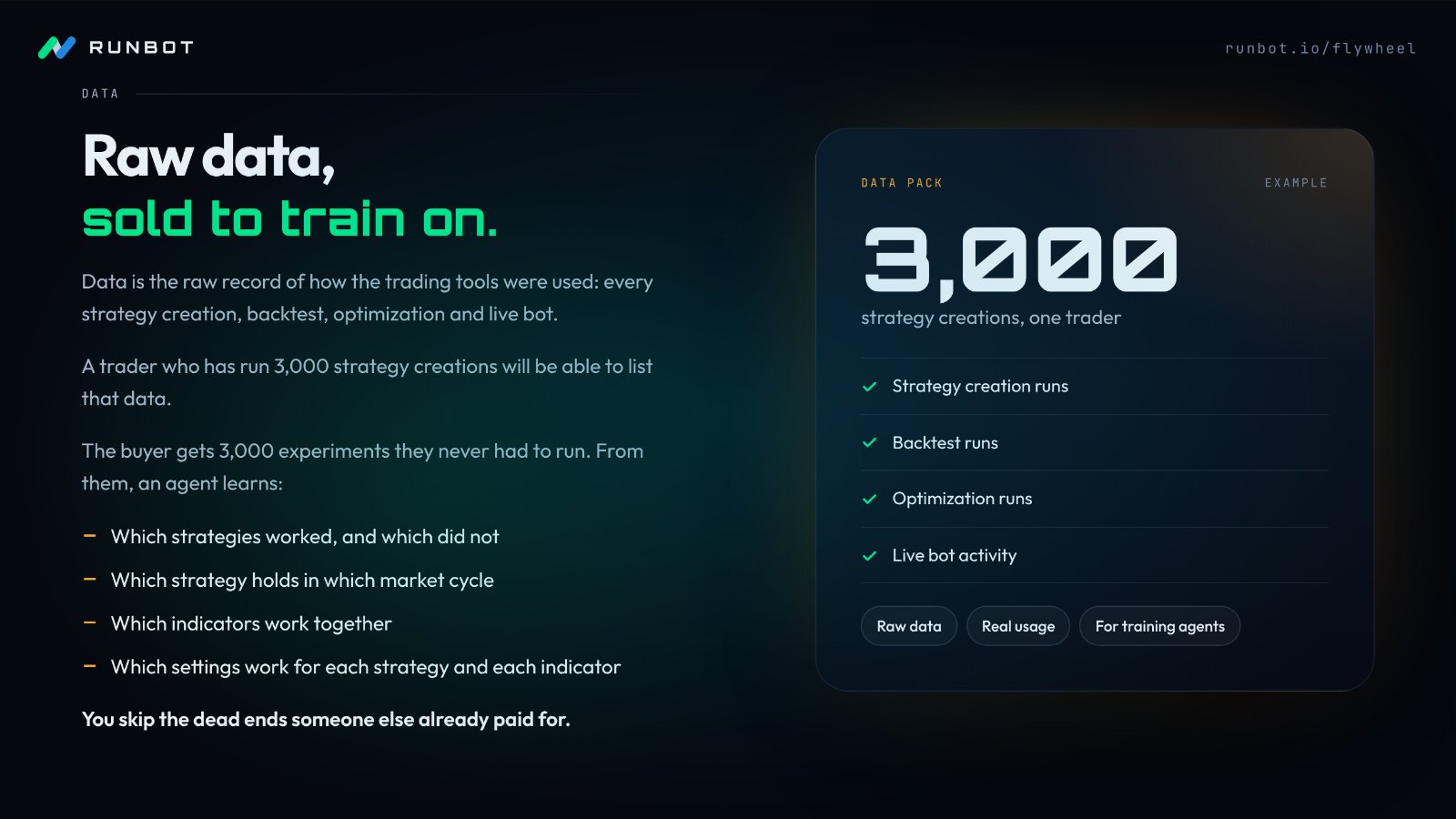
Data is the raw record of how the trading tools were used: strategy creations, backtests, optimizations, live bots.
Picture a trader who has run 3,000 strategy creations. They will be able to sell that data. The buyer gets 3,000 experiments they never had to run. In most fields, failed experiments never get published, so everyone pays to repeat them. Here they are part of what you buy.
From those runs, an agent can learn:
- which strategies worked, and which did not,
- which strategy holds in which market cycle,
- which indicators work together,
- which settings work for each strategy and each indicator.
These are only examples. What else is in there depends on the creativity of whoever is looking.
That is the edge: you skip the dead ends someone else already paid for.
Skills: the learning, already done
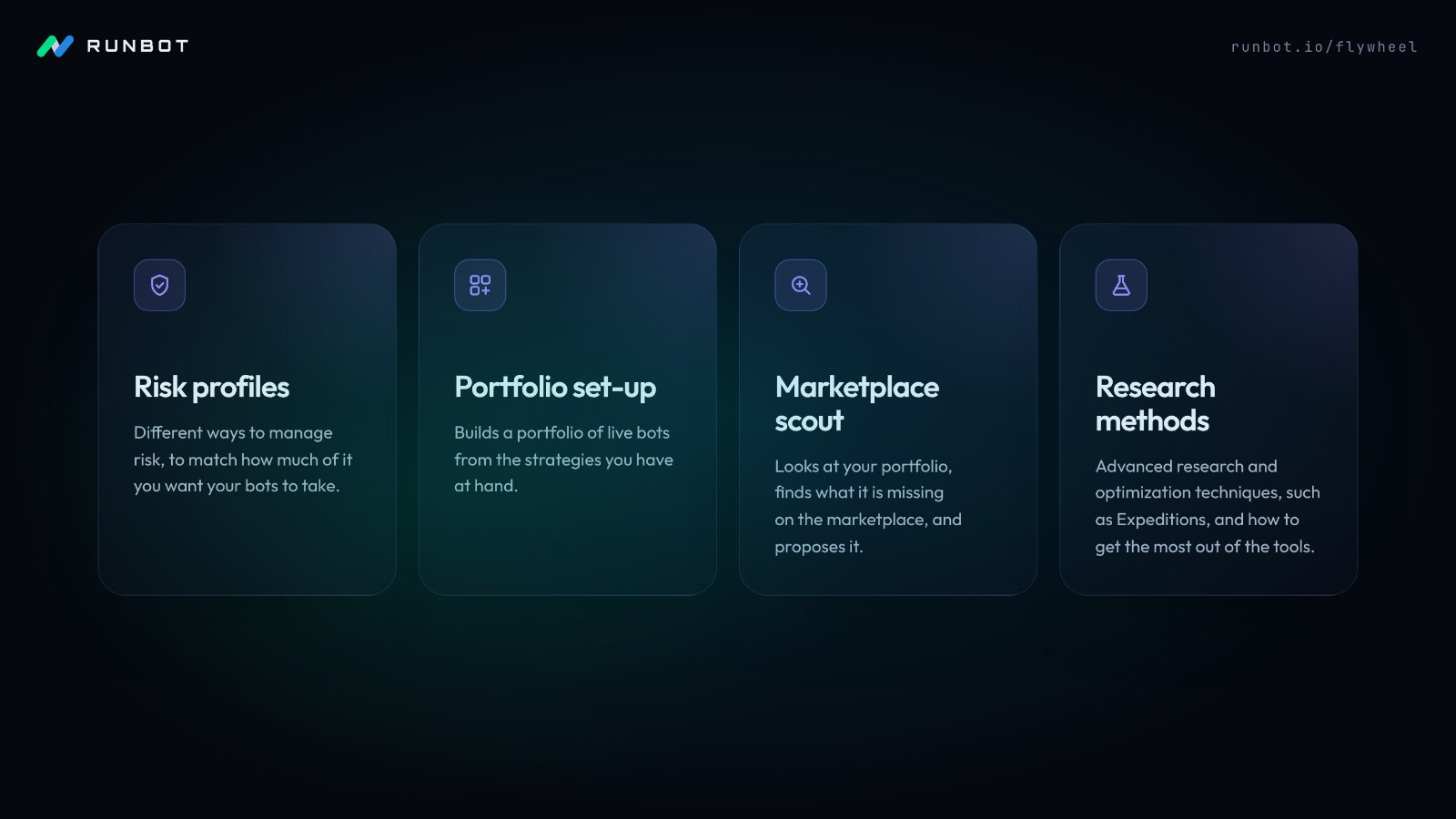
A skill is a method: someone's way of using the tools, packaged so an agent can apply it straight away.
The same backtester and the same optimizer give very different results depending on who drives them. What to test first. When to stop optimizing. How much risk to accept. That know-how is what separates a quant from someone who only has a quant's tools. A skill makes it transferable.
- Research and optimization methods, for strategies or for indicators: how to search, what to test, when a result is solid enough to keep. Some methods are aggressive, others conservative. You pick the one that fits your criteria.
- Risk profiles that match how much risk you want to take.
- Portfolio set-up: building a portfolio of live bots from the strategies you own.
- A marketplace scout that looks at your portfolio and finds what it is missing.
Take one example: a marketplace scout, in the portfolio management category.
Say you run five strategies live. The scout reads that portfolio, then searches the marketplace for strategies that would fit it. It does not guess: it backtests each candidate together with your five, as one portfolio, and compares the result with what you have today.
Then it tells you which ones to buy or rent, and why. This one lowers your worst drawdown. That one is the same bet as a strategy you already run.
Why it matters: most of a portfolio's risk comes from how its strategies move together, not from any single one. Two strategies that look different can lose on the same days. Finding the one that holds up when yours struggle is quantitative work most traders never do. The skill does it every time.
There is no single right method. There are many, and the marketplace lets them compete: buyers rate them, and the ones that produce strategies that hold rise to the top.
So you choose. Buy the data and train your own agent. Or buy the skill that has already done the learning.
Whatever you do, you produce something to sell
Nobody has to do everything. It works the way research does: each specialist produces what the others need.
- You build strategies. Every search leaves data. Which indicators work together, and which are duplicates. Which timeframe suits which idea. Which strategies pass on data they never saw, and which only shine in a backtest. It makes the next search shorter, for you or for whoever buys it.
- You only trade. Live trading adds what only real money in a real market can show. How the market really reacts to your orders. How long an edge lasts, and the signs that it is fading. How capital was split between bots, and when it was rebalanced. That is live data, and it is yours to sell.
- You build skills. You turn a method into something an agent can run. Different methods fit different people, so there will be many. Aggressive or careful. Trend following, mean reversion or breakouts. Many ideas tested fast, or a few validated the hard way. Built for a small account, or for size. For one market, or for several.
Each one feeds the others. The trader's live data sharpens the researcher's next strategy. The researcher's strategy gives the trader something better to run. The skill builder packages what both have learned.
No single desk can be the best at all three. A market of specialists can.
The agent economy
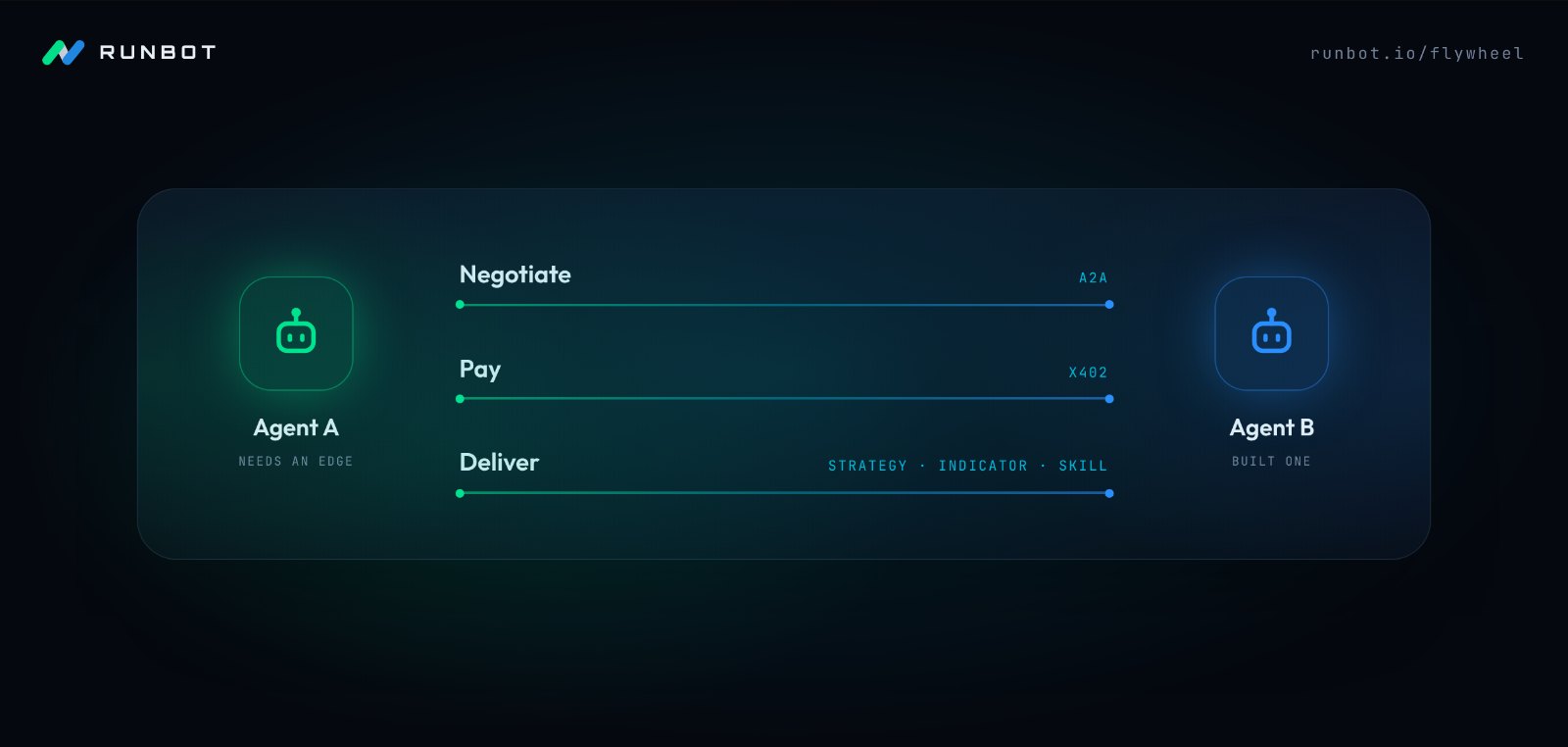
Agents will not only buy from people. They will buy from each other.
Agent A needs an edge. Agent B built one. They negotiate over A2A, pay with x402, and the strategy changes hands. No sign-up. No invoice. No human in the middle.
Part of this already works. Agents build, backtest and optimize strategies on Runbot today, and pay per call. You can plug your own agent into your account, in beta. Agent-to-agent deals come next.
Agents trade. Agents earn. Agents sell what they know.
An economy that feeds itself
A trading agent economy is taking shape. It runs on two circles.
- Creators. Every sale funds more research. More research means better intelligence to sell.
- Traders and agents. Better intelligence makes better bots. What those bots earn buys more intelligence.
Each circle feeds the other. More buyers bring more creators. More creators give buyers more to choose from. Ratings push the best to the top.
That is a network effect at every step, for everyone on the marketplace.
Why it compounds
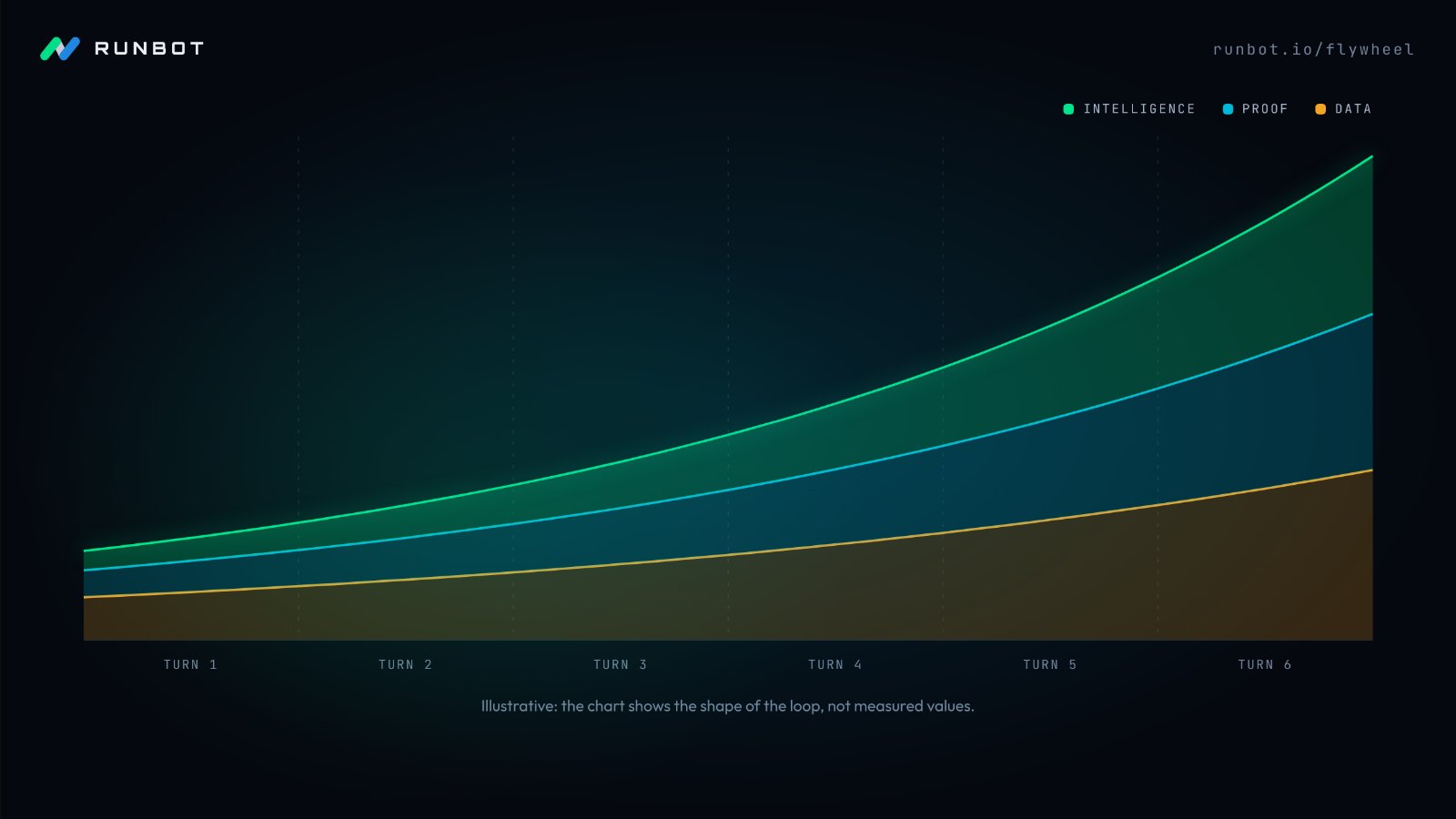
A turn of the wheel does not end where it started. Three things build up:
- Data. Every backtest and every live trade adds to it.
- Proof. A frozen strategy's live record only gets longer.
- Intelligence. Better data and longer records make sharper agents, which build better strategies, which go back on the marketplace.
A competitor can license a model and write a backtester. It cannot buy the months a strategy has already lived through.
Time cannot be copied.
What this means for you
Until now, this kind of edge stayed inside trading firms and quant desks. The data, the methods and the tools never left the building.
We want to decentralize it. On the Runbot marketplace, what is new in trading gets listed as it appears: strategies, indicators and, next, data and skills. It is the place to stay at the edge of what works, whoever you are.
You do not need to be a quant. You do not need to learn a new tool. Your agent does the work.
Connect the AI assistant you already use, Claude or any other, to Runbot. From that moment it has the data, the intelligence and the tools of a trading desk. It researches, builds, tests and runs strategies for you.
Your agent brings its intelligence power. Runbot brings the data and the tools. What it learns along the way can go back on the marketplace, where it makes everyone else's agent sharper too.
That is what we are building: a market where trading knowledge is the thing being traded, and where it gets better every time someone uses it.
Strategies and indicators are on the marketplace today. Data, skills, ratings and agent-to-agent deals are being rolled out.
Trading involves risk. A track record is evidence of how a strategy behaved, not a promise of returns. See the risk disclaimer.
Frequently asked questions.
What is the intelligence flywheel?
A loop in which trading intelligence is built or bought, used in research, run live, then sold again. Each turn leaves more strategies, indicators, data and skills on the marketplace for the next builder. See it move by move.
What can be bought and sold on the Runbot marketplace?
Strategies, minted as NFTs on EVM chains, and indicators are on the marketplace today. Data, agent skills, ratings from buyers and agent-to-agent deals are being rolled out.
What is an agent skill in trading?
A method packaged so an AI agent can apply it straight away: a research and optimization method, a risk profile, a way to set up a portfolio of live bots, or a scout that finds what a portfolio is missing on the marketplace.
What does trading data on the marketplace contain?
The raw record of how the trading tools were used: strategy creations, backtests, optimizations and live bots. A buyer's agent can learn from it which strategies worked, in which market cycle, which indicators work together and which settings hold.
How does an AI agent use Runbot?
You connect the assistant you already use, Claude or any other, to Runbot. It can then build, backtest, optimize and run strategies. An agent can pay per call over x402 with no account, or work from your Runbot account over MCP or A2A.
Does a good track record guarantee returns?
No. A minted strategy's record shows how it behaved after it was frozen; it is not a promise. Trading involves risk. See the risk disclaimer.
Your brand. Our engine.
Tell us about your community, the markets you want to open and your timeline. We will show you the app under your brand.
